

Trying to share your latest book or album can feel impossible when social media rules change overnight. For independent authors and musicians, a user-friendly website is more than just a digital business card—it is your central hub for connecting with fans on your own terms. Setting up a professional site lets you control your brand, showcase your work, and turn visitors into loyal readers or listeners without relying on unpredictable platforms.
Key Takeaways
Point | Details |
|---|---|
Author Website as a Hub | Your author website is essential for building your brand, offering control over your audience that social media cannot provide. |
Key Features | Ensure your site includes a clear bio, organized book catalog, newsletter signup, and contact information for effective reader engagement. |
Optimizing Content | Utilize SEO practices to enhance visibility and make it easy for readers to find and purchase your books or music. |
Common Mistakes | Avoid perfectionism, procrastination, and neglecting marketing; consistent effort and self-promotion are crucial for long-term success. |
What Defines an Author Website Today
Your author website isn’t just a digital business card anymore. It’s your central hub for building your author brand and connecting with readers worldwide. Think of it as the one place you control entirely—unlike social media platforms that can change their rules overnight.
Modern author websites serve multiple purposes at once. They showcase your books, build your reader base, and establish your credibility as a professional author. A central hub for an author’s professional brand gives you ownership and control that no social media platform can offer.
Core Functions of Today’s Author Websites
Here’s what separates a basic author site from one that actually works:
Direct reader connection: Build your email list without depending on algorithm changes
Complete portfolio: Display all your books, upcoming releases, and behind-the-scenes work
Search engine visibility: Appear in Google searches when readers look for your name or genre
Ownership and control: Everything stays yours—no platform can delete your account
Professional credibility: A polished site signals you’re a serious author
The best author websites today include essential features like biography sections, book information, contact details, and newsletter signups that make it easy for readers to learn about you and stay connected.
What Your Site Actually Needs
Forgot the complicated stuff. Your author website works best when it includes:
A clear author bio that tells your story
An organized book catalog with descriptions and purchase links
A newsletter signup form (your most valuable asset)
Regular blog posts or updates about your writing
Social media links to connect across platforms
Contact information or a contact form
These elements work together to turn browsers into loyal readers. When you optimize your content for search engines, people actually find your site instead of you chasing them on social media.
Your author website is the one place you control completely. Every other platform owns your audience; your website lets you own the relationship.
The difference between authors who build a sustainable career and those who struggle often comes down to one thing: they have a real home base online. Your website gives readers a place to find everything about you, buy your books, and stay connected for the long term.
Pro tip: Start simple with your author website. You don’t need every feature immediately—focus on a clean bio, your books, and a newsletter signup, then expand as your author career grows.
Popular Author Website Types and Features
Not all author websites look the same, and that’s actually a good thing. Your site should reflect your books, your genre, and your personality. Some authors need a simple portfolio, while others run complex platforms with multiple revenue streams.

Let me break down the main types and what makes each one work for different author situations.
The Essential Features Every Author Site Needs
Before we talk about types, here’s what almost every successful author website includes:
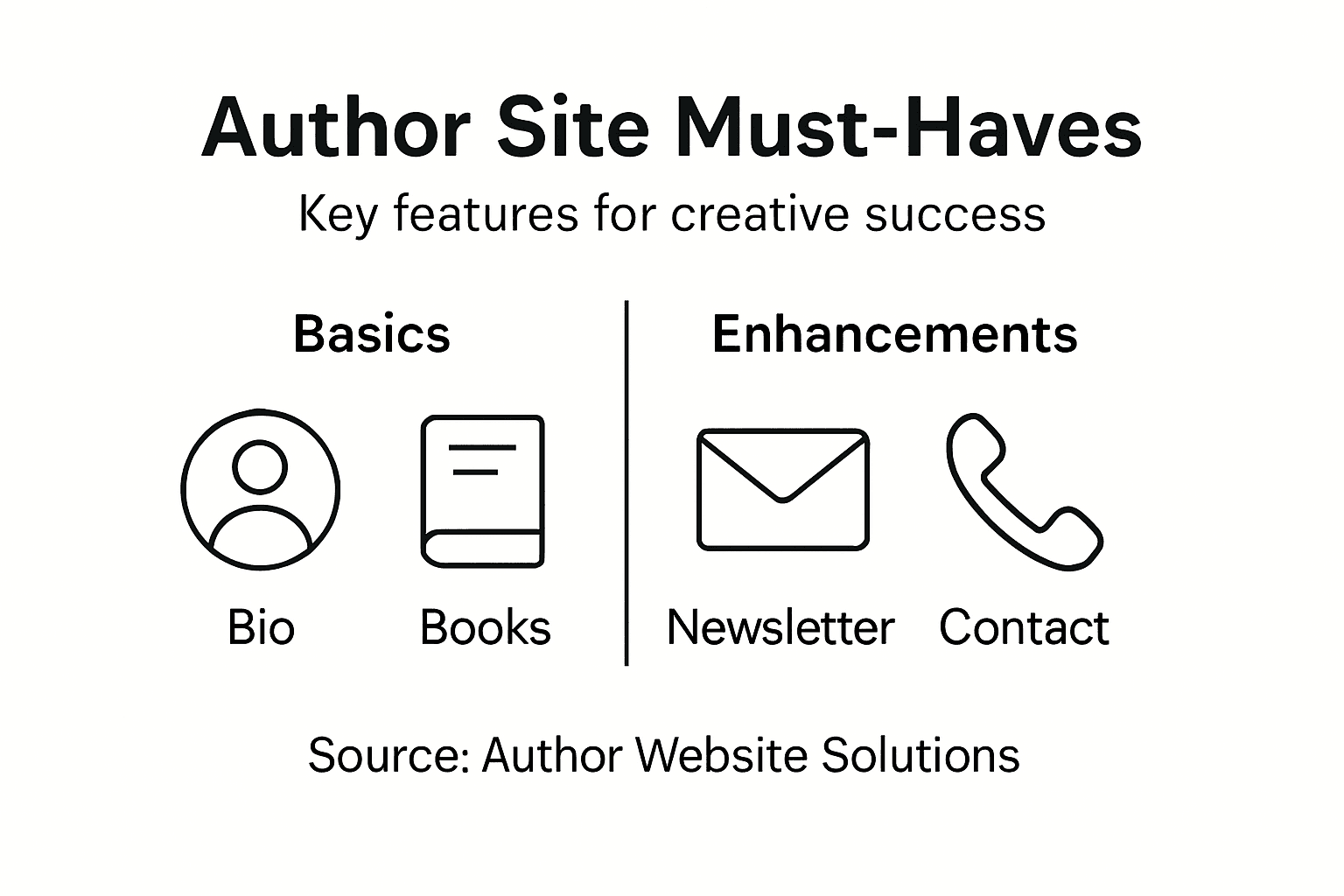
Compelling homepage: A captivating banner and headline that immediately tells visitors who you are
Author bio: Your story, credentials, and why readers should care about your work
Book information: Clear descriptions, covers, and purchase links for all your titles
Email newsletter signup: Your most valuable reader connection tool
Blog or news section: Regular updates keep visitors returning and improve search rankings
Social media links: Direct readers to where else they can follow you
Contact information: Make it easy for readers, press, and business inquiries to reach you
Mobile-friendly design ensures your site works perfectly on phones and tablets where most readers browse. A visually appealing layout that matches your genre builds trust instantly.
Types of Author Websites
I’ve seen author sites fall into a few main categories:
The Minimal Portfolio works for authors just starting out. It includes your bio, current books, and a newsletter signup. Nothing fancy, but it gets the job done and builds your email list.
The Author Hub is more comprehensive. You add a blog, behind-the-scenes content, reader engagement tools, and maybe a shop. This type works great if you’re building a loyal community around your brand.
The Publishing Platform happens when an author runs their own publishing business or manages multiple author accounts. This type needs more complex features like advanced analytics and multiple user accounts.
Here’s a comparison of author website types to help you choose the right approach:
Website Type | Best For | Key Advantages | Typical Next Steps |
|---|---|---|---|
Minimal Portfolio | New authors | Easy setup, quick launch | Add more features as you grow |
Author Hub | Growing reader communities | More engagement, keeps readers loyal | Integrate blog, shop, events |
Publishing Platform | Authors managing multiple brands | Advanced control, business scalability | Manage teams, analyze performance |
Your website type should match where you are in your author journey, not where you think you should be.
What Makes Features Actually Matter
Here’s what I’ve learned: not every feature matters equally. Focus on these first:
A clear, welcoming homepage
Your book catalog with purchase links
An email newsletter signup
A way for readers to contact you
Mobile responsiveness
Once those are solid, then consider adding a blog, reader testimonials, or advanced reader copies signup. The goal is making it easy for readers to buy your books and stay connected.
The design should reflect your genre and author brand. A romance author’s site looks different from a thriller writer’s site. That’s perfect. Your design choices tell readers what to expect.
Pro tip: Start with the minimal portfolio type and add features as you grow. Most successful authors don’t need everything at launch—they build their sites alongside their careers.
How Instant Website Builders Work
Instant website builders sound almost too good to be true—but they actually work exactly like their name suggests. You don’t need to code, hire a developer, or spend weeks learning technical skills. These platforms handle the heavy lifting so you can focus on your actual work.
Let me walk you through how they actually function and why they’re game-changers for authors.
The Core Technology Behind Instant Builders
Here’s what happens behind the scenes when you use an instant website builder:
Drag-and-drop editor: Click, drag, and drop elements where you want them. No coding required
Pre-built templates: Start with a design already optimized for your type of content
Built-in tools: Content management, SEO, analytics, and hosting all included
Automatic hosting: Your site lives on their servers—you don’t manage technical infrastructure
Mobile optimization: Your site automatically adapts to phones, tablets, and desktops
Customizable templates and drag-and-drop editors let you create professional-looking sites in minutes instead of months. You pick a design that matches your genre, customize the colors and text, and you’re basically done.
Why This Matters for Authors
The traditional way of building a website meant learning HTML, managing servers, and troubleshooting technical problems. That kept many authors stuck without a web presence.
Instant builders remove every technical barrier. You’re not fighting with code or paying someone $2,000 to build your site. You’re creating something professional in an afternoon.
They also handle SEO optimization and mobile adaptation automatically, which means your site actually shows up in Google searches and works perfectly on phones.
What You Actually Get
When you launch a site with an instant builder, you’re getting:
A live website hosted on secure servers
Built-in email forms and contact tools
Analytics to see who visits and what they click
Mobile-responsive design (no extra work needed)
SEO features to help readers find you
Content management so you can update your site yourself
You own the content and your site. You’re not locked into a subscription forever if you decide to move it elsewhere.
Instant website builders turn authors into website creators without requiring technical skills or months of learning.
The speed is what really changes things. I’ve seen authors go from “I need a website” to “my website is live” in the same day. That’s not hyperbole—that’s actually how fast these tools work now.
Pro tip: Choose a builder that doesn’t require you to learn anything new. The best platform is the one you’ll actually use consistently to update your content and grow your audience.
Showcasing and Selling Books or Music Online
Having a website is only half the battle. The real challenge is making sure people actually see your work and know how to buy it. Your site needs to do two things simultaneously: showcase your creativity and facilitate sales.
I’ve learned this matters because most readers and listeners won’t hunt you down. You need to make buying your books or music effortless.
Displaying Your Work Effectively
Your catalog is the centerpiece of your sales strategy. Everything revolves around presenting your books or music in a way that makes people want to purchase immediately.
Clear, compelling product listings with detailed descriptions matter more than you’d think. Tell readers what your book is about, who should read it, and why it’s different. For musicians, include track listings, genre information, and what listeners can expect.
High-quality images and detailed descriptions build trust and make your work stand out. A professional book cover preview or album artwork goes a long way. Show readers exactly what they’re buying.
Add context around each piece:
For authors: Word count, genre, publication date, and series information
For musicians: Album length, song list, production details, and listening platform links
For both: Price, where to buy, and samples or previews when possible
Making the Sale Simple
You can have the best work in the world, but a complicated checkout process kills sales. Your website needs to make purchasing frictionless.
Link directly to where readers can buy. That might be Amazon for authors, Spotify and Apple Music for musicians, or a direct store on your website. Don’t make people search—put the links right there.
User reviews and community feedback are your most powerful sales tools. Ask readers to leave reviews. Share testimonials. Let potential buyers see that real people loved your work.
Consider these sales channels:
Your website store (you keep more revenue)
Amazon or major book retailers
Spotify, Apple Music, or streaming platforms
Direct email to your newsletter list
Social media links to purchase pages
Building Reader and Listener Trust
Trust drives sales more than anything else. A professional website, responsive communication, and genuine engagement with your audience all build that trust.
Respond to messages quickly. Answer questions about your work. Thank people who buy from you. This creates a community around your work, not just customers.
The most successful creators sell through relationships, not transactions. Your website is where those relationships begin.
Show your personality and process. Let people know you’re a real human behind the work. This transforms casual browsers into loyal fans who actively promote your work to others.
Pro tip: Add a sample chapter or song preview to your website so visitors can experience your work before buying. This reduces buyer hesitation and increases conversion rates significantly.
Key Mistakes and Success Factors for Creatives
I’ve watched talented authors and musicians sabotage their own success without realizing it. Sometimes it’s not about talent or hard work—it’s about avoiding the traps that catch almost every creative at some point. The good news? Most of these mistakes are completely avoidable once you know what they are.
Let me share what actually matters for long-term creative success.
The Mistakes That Hold You Back
These are the patterns I see over and over:
Perfectionism: Waiting for your website or work to be perfect before launching it. Perfect never comes.
Procrastination: Delaying the work that actually builds your career. Days turn into months.
Neglecting marketing: Creating great work but telling nobody about it. Silence equals invisibility.
Underpricing your work: Charging too little because you doubt your value. This trains audiences to undervalue you.
Comparing yourself to others: Measuring your progress against someone else’s highlight reel. It kills motivation.
Trying everything alone: Not building a network or asking for help. Isolation limits what you can achieve.
Inconsistent content creation: Publishing sporadically instead of building a regular rhythm. Audiences need consistency.
Waiting for perfect opportunities instead of creating them keeps many creatives stuck. The successful ones start before they’re ready.
Below is a summary of mistakes that hold creators back and strategies that drive success:
Common Mistake | Success Driver | Why It Matters |
|---|---|---|
Waiting for perfection | Launching and iterating | Momentum builds with action |
Procrastinating work | Consistent content schedule | Audiences expect regularity |
Neglecting promotion | Natural, steady self-marketing | Visibility grows your audience |
Comparing to others | Focusing on self-improvement | Motivation stays resilient |
What Actually Drives Success
Here’s what separates creators who build sustainable careers from those who struggle:
Consistent effort over time matters more than raw talent. Show up regularly. Create regularly. Publish regularly. This rhythm builds momentum.
Building networks and community multiplies your reach. Connect with other creators, readers, and listeners. Support others genuinely. These relationships become your greatest asset.
Self-promotion that feels natural is non-negotiable. Your best work doesn’t sell itself. You have to tell people about it, and you have to do it consistently.
Learning from mistakes accelerates growth. Reflecting on errors and turning them into lessons builds resilience and helps you avoid repeating the same problems.
Success factors include:
Creating opportunities proactively instead of waiting
Pricing your work appropriately for its value
Maintaining consistent communication with your audience
Investing in your skills and knowledge continuously
Protecting your time and mental health
The creatives who succeed aren’t always the most talented. They’re the ones who show up consistently and treat their work like a real career.
I’ve seen mediocre work succeed because the creator marketed it relentlessly. I’ve also seen brilliant work disappear because the creator never told anyone about it. This tells you something important: visibility beats perfection every single time.
Pro tip: Pick one mistake you recognize in yourself and commit to fixing it this month. Usually one change—like posting content consistently or finally launching your website—creates momentum that fixes several other issues automatically.
Build Your Author Website with Instant Ease and Complete Control
Struggling to turn your author website into a true reader connection hub Without getting stuck on technical barriers or endless delays you need a solution designed just for creatives like you. Our instant website builder lets you create a professional author site in no time using your ISBN numbers. Gain the ownership and control you deserve and showcase your books with clear catalogs and seamless sales integration to build your email list and community effortlessly.
Start taking control of your author journey today by choosing a platform that handles SEO, mobile responsiveness, and built-in marketing tools automatically. Don’t wait for perfection launch your site and grow your brand consistently with Instant Website Builder for Authors and Musicians. Explore how a custom CMS or personalized website can elevate your career now at The Digital Fair.
Unlock your full potential and make your author website the true home base your readers are searching for.
Frequently Asked Questions
What are the essential features every author website should have?
Every author website should include a compelling homepage, an author bio, book information with purchase links, an email newsletter signup, a blog or news section, social media links, and contact information.
How can authors optimize their website for search engines?
Authors can optimize their website by using relevant keywords throughout their content, creating high-quality blog posts, ensuring mobile responsiveness, and having clear navigation which helps search engines index their pages effectively.
What type of author website is best for new authors?
A minimal portfolio website is often best for new authors. This type includes a clear author bio, current books, and an email newsletter signup. It’s easy to set up and allows for growth as their career develops.
How do instant website builders help authors create their sites?
Instant website builders simplify the process for authors by offering drag-and-drop editors, pre-built templates, built-in tools for SEO and analytics, and automatic hosting. This allows authors to focus on their content without needing technical skills.